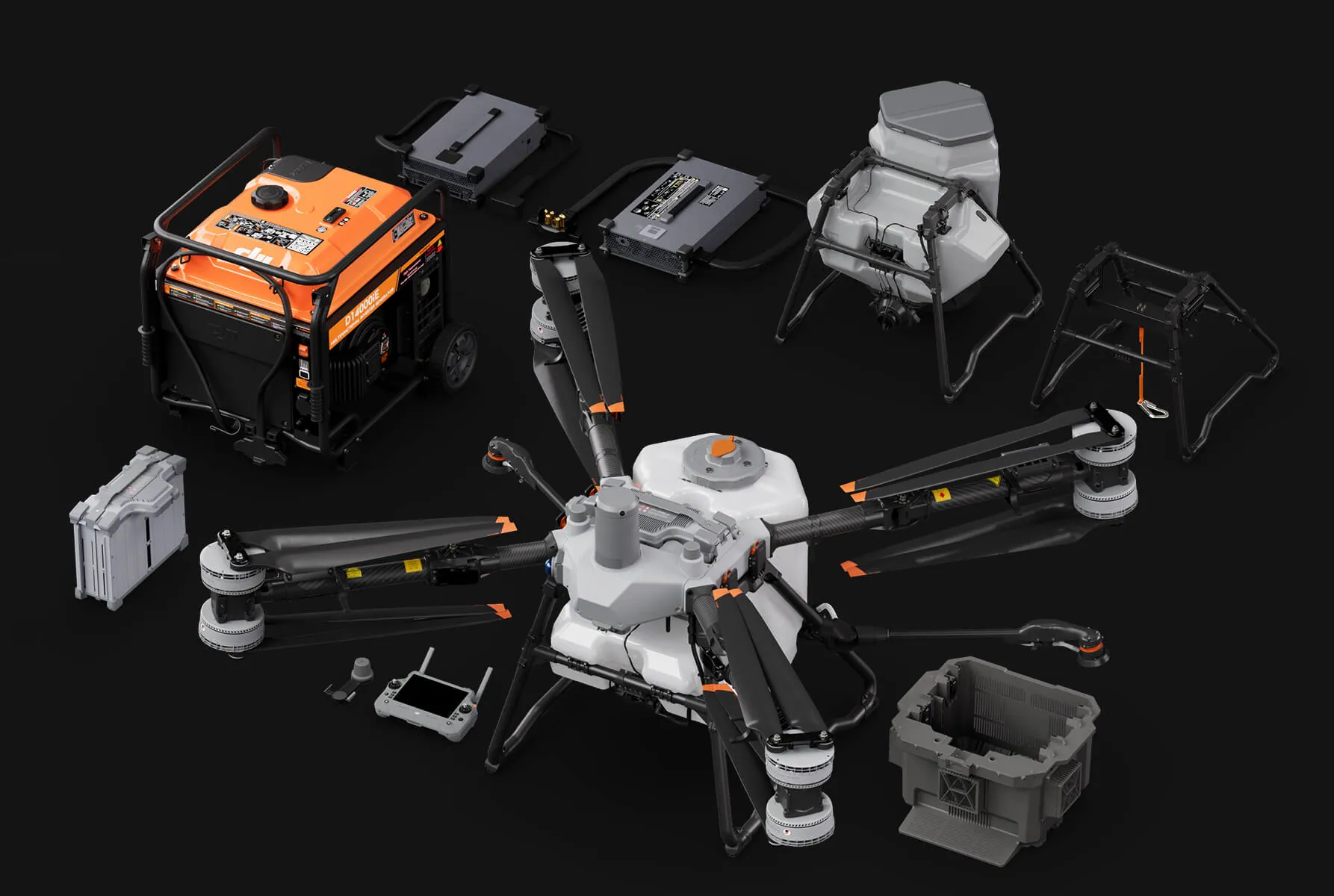
Which aircraft fits my job, my crew and my window?
Aircraft choice follows the job, the crew and the work window. The right spraying drone completes the task within the approved operating weight, the measured work window and the crew you can field. Material, task area, target rate and field logistics decide the model, and a catalogue payload figure does not. Compare the two Agras aircraft on crop spraying work you actually have.
Start with material, area and target rate
The material decides the hardware before any model comparison matters. A broadcast suitable dry material or an eligible liquid application starts with the task and what the team must deliver, and an application aircraft then needs material handling, power, calibration and a workable crew plan. A workable comparison defines the task area, material and target rate first, then checks the required product, site, pilot and airspace conditions.
Where the DJI Agras T50 fits
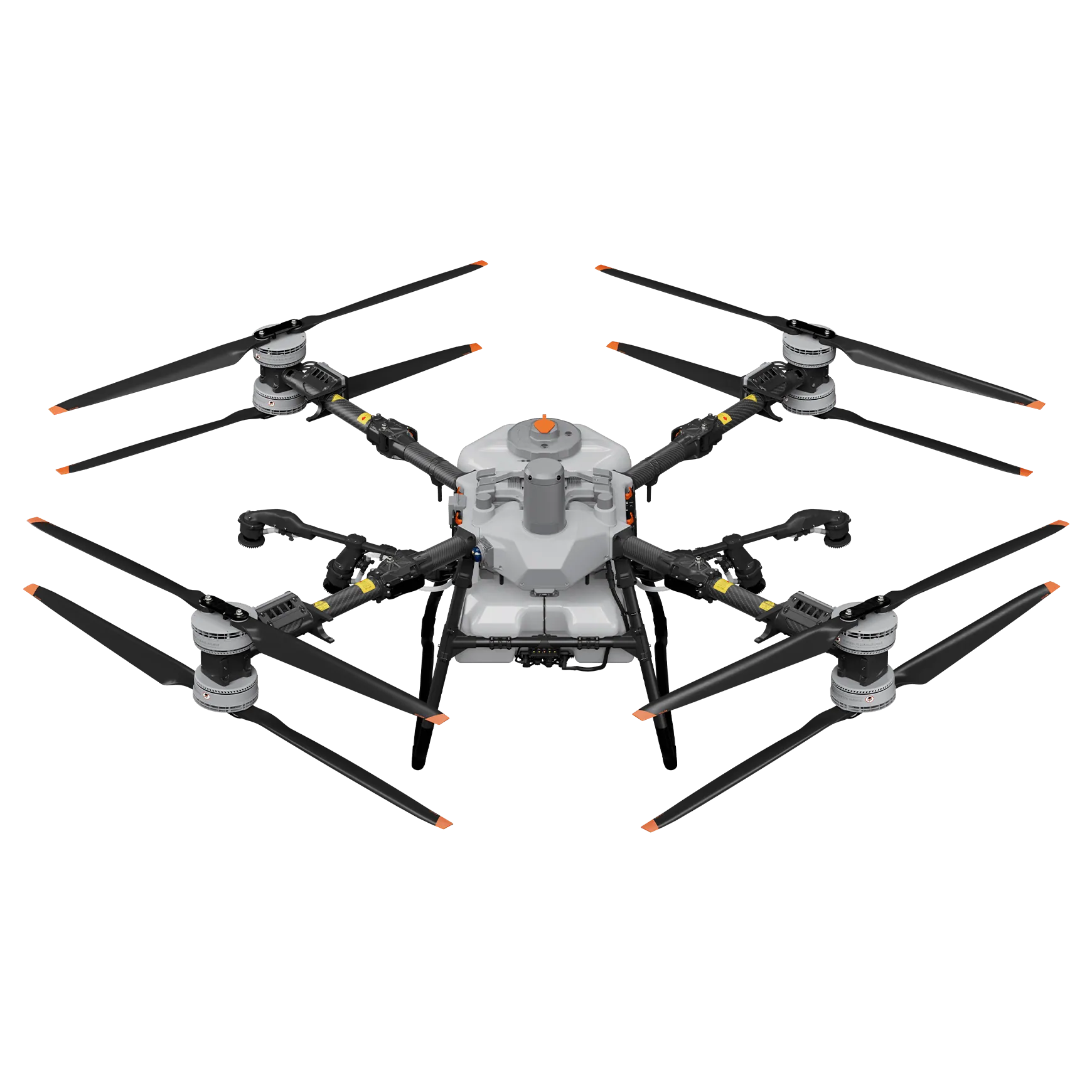
The DJI Agras T50 suits a defined dry or liquid task that a smaller payload system can finish inside the work window. The T50 is an application aircraft for growers, farm crews and custom operators, and it is the starting point when a defined dry material or liquid task can meet its window with a smaller payload system than the T100. Compatible dry seed goes out through the dedicated T50 spreader with calibration at the target rate, a spread pattern sample and a ground check on emergence. Crop liquids use standard two-sprinkler or optional four-sprinkler hardware where the operation and the product are permitted.
Where the DJI Agras T100 fits
The DJI Agras T100 deserves a closer look when refills, not catalogue capacity, limit the job. The T100 is a larger application aircraft for teams that can use a heavier system within an established operating plan, and it is worth considering when a measured field trial shows that refills are the limiting step. Running a T100 means supporting transport, loading, charging, crew safety and the permitted operating weight. DJI lists the T100 with a 100 L spray tank and a 150 L spreading hopper.
What do I need to configure and weigh before choosing?
Configuring and weighing an agricultural drone begins with more than the airframe. SpeedyDrone compares field setups as a whole, covering the aircraft, controller, spray or spreading hardware, batteries, charger, power source, spares, consumables and software, and confirms before ordering what the job actually needs. Weighing the fitted aircraft with batteries, attachments and material is what sets the Canadian operating path.
List each component and its condition
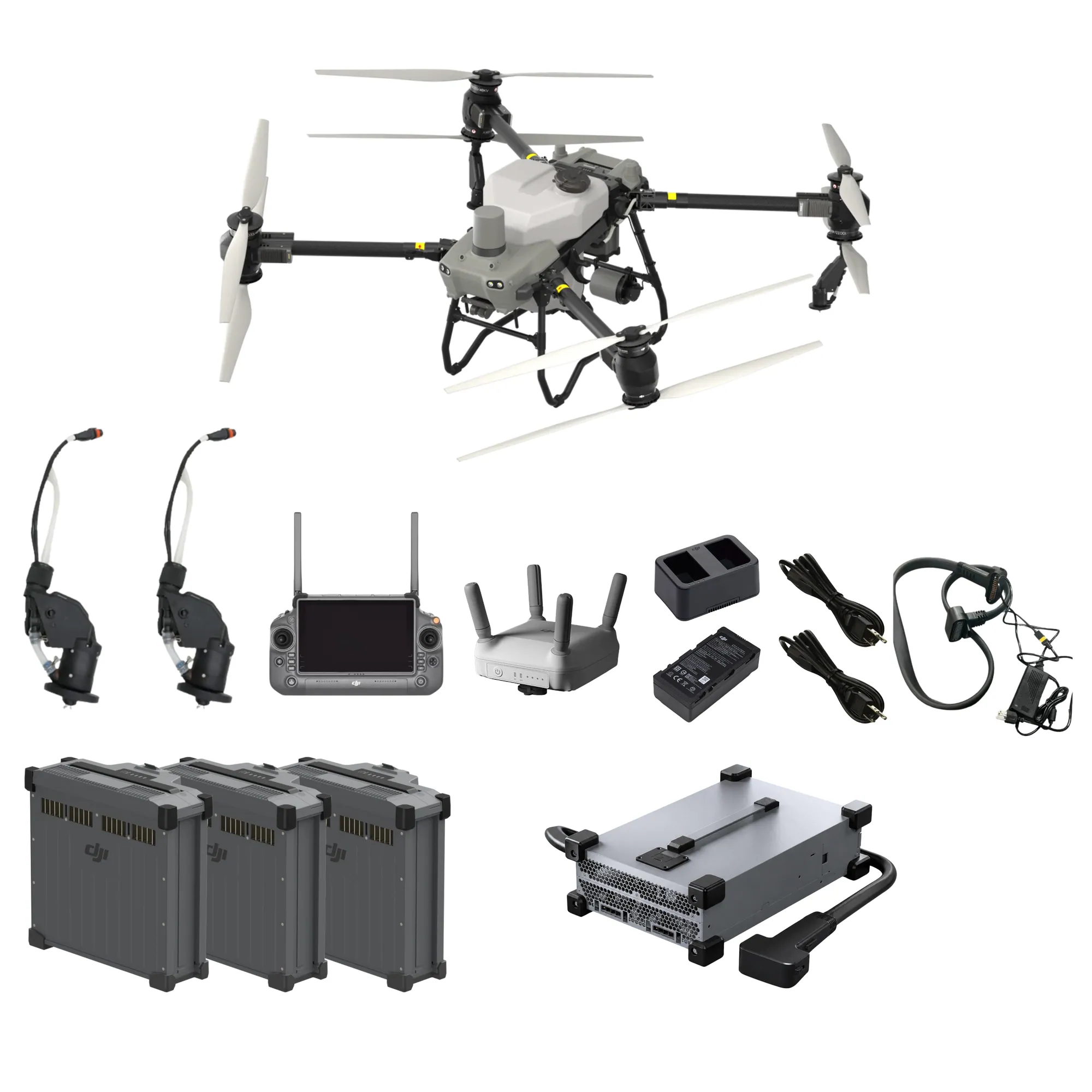
A configuration quote should show each component, its condition and its model number, including aircraft, controller, payload hardware, batteries, charger, cables, power source, spares, consumables and software. Region-specific components, the support arrangement, handover and training are confirmed separately from the aircraft. Confirm the battery and charger arrangement for the intended kit on the field kit options page.
Know what the T50 options include
The new DJI Agras T50 aircraft-only offer excludes flight batteries, charging equipment and the spreader. The three-battery Pro package includes a new airframe and RC Plus with a pre-owned charging station and three pre-owned flight batteries. The pre-owned offer and the optional orchard or spreading equipment are reviewed on their own, and the written quote should identify condition, included items and current fulfilment.
Weigh the fitted aircraft to find the operating path
Actual operating weight includes the full battery, attachments, material and other carried items, and the most restrictive equipment, operator, site and legal condition applies. DJI publishes T50 maximum takeoff weights of 92 kg for spraying and 103 kg for spreading under its reference configurations, and those are manufacturer ratings rather than a permission to fly.
| What is compared | DJI Agras T50 | DJI Agras T100 |
|---|---|---|
| Standard liquid system | 40 L nominal, 40 kg OEM maximum | 100 L nominal, 100 kg OEM maximum in the standard LS100 |
| Dry spreading hardware | Dedicated 75 L hopper, 50 kg maximum material load, 0.5–5 mm compatible dry granules | Dedicated 150 L hopper, 100 kg OEM maximum |
| Maximum takeoff weight listed by DJI | 92 kg spraying, 103 kg spreading | 175 kg for standard spray or spreading, 177 kg for four nozzles |
| Canadian weight gate | Confirm the actual configuration, declaration, mission, pilot and airspace | Above 150 kg actual operating weight needs an SFOC-RPAS under CAR 903.01(a) |
How much acreage makes an Agras worth buying?
Acreage alone cannot answer the purchase question. SpeedyDrone starts with the job that repeats, the field work window and the cost or capacity of the current method, then compares owning with the alternatives the farm actually has. A smaller farm or occasional use can still be a good fit for scouting or a properly scoped trial.
Measure a full cycle, not one flight
A measured cycle covers repositioning, filling, flight, return, battery handling, recharge and cooling, with allowance for moves between blocks, wind, replenishment, maintenance and a weather reserve. Initial coverage per fill comes from usable load divided by target rate when the units match, and a dispatch estimate divides the actual task area by measured field coverage. Catch trays or another appropriate field check confirm the number.
Compare against the method you run now
A fair comparison uses actual hectares treated or mapped per pass, so repeat visits and partial blocks stay visible. Ownership adds annualized equipment and field kit, training, insurance, licences, software, storage and maintenance, plus pilot and crew time, travel, power, consumables, calibration, weather rework and data processing. A contracted job is compared on net cost for the same output.
What buyers say about budget, batteries and scale
Buyers who contact SpeedyDrone often say the model they want sits outside their price range, and some say they will start with three batteries once they see what extra batteries cost. Other buyers say a larger drone is hard to justify while their acreage is small, and they ask whether a demonstration or a pre-owned unit would close the gap, or they need the funded configuration to stay under a cap. Payment options are set out on the equipment financing options page.
Will it work on my crop, and what changes from my current method?
Crop fit is a measured question, not a brochure question. SpeedyDrone hears crop-fit questions first: whether spray reaches the inside of the trees from top to bottom, whether canopy penetration holds when plants are full size, and whether the seeding rate can be calibrated correctly. A trial on the real crop answers those questions better than a specification table.
Questions that come up before a trial
Buyers also ask how the work would be staffed, what other equipment the operation would need, and how long the aircraft stays relevant if the technology changes quickly. Some ask to spray a real foliar nutrient so they can follow the whole process from mixing to deposition. A trial is scoped around the crop, the material and the checks that decide whether the work met the standard.
Compare against the method you run today
Farms and researchers tell SpeedyDrone they already own a sprayer and want to know what would change, that their work is all organic handwork, or that they are too small for this equipment. They also say broadcast seeding is cheaper unless the trial is free, that multispectral imagery adds little over their own tissue sampling at their size, and that a drone cannot work seed into the soil. Compare the drone job with the method it would replace, on the same field and the same acceptance standard.
Match the hardware, the label and the field checks
A compatible dry seed job checks the actual lot and any coating, calibrates at the target rate, samples the spread pattern and ground-checks emergence. Granular work on a T100 uses the dedicated Spreading System 4.0 with the approved auger and a material-specific calibration, plus dry lot sampling, bulk density and size checks, calibrated catch trays, rate and pattern acceptance and ground verification. An orchard or vineyard liquid job needs the label and provincial requirements, terrain and wires, clearance, wind and buffers, water and loading, and a deposition check, and four nozzles do not by themselves improve target coverage. Task detail sits on the orchard and vineyard spraying and cover crop seeding by drone pages.
What Canadian rules apply to an ag spray drone?
Canadian rules for an ag spray drone state that a hardware configuration does not authorize pesticide use. The aircraft, the pilot, the airspace, the product and the provincial requirements are checked together. Health Canada's current RPAS guidance and the current label for the exact product, crop or site and use are checked before a treatment is quoted. Loaded weight decides which flight path applies, so eligible weight is settled before any comparison of work rate.
A loaded aircraft above 150 kg needs an SFOC
A flight with an actual operating weight above 150 kg requires an SFOC-RPAS under CAR 903.01(a), and that weight includes the fitted components and the material carried. DJI lists a 175 kg maximum takeoff weight for the standard T100 spray or spreading configuration and 177 kg for the four-nozzle spray configuration. At or below 150 kg, eligibility still depends on the actual configuration, the relevant declaration, the mission, the pilot and the airspace. The Canadian spraying regulations page sets out the checks.
Label, site and deposition checks
Ontario or Québec requirements for the actual operation are checked before a date is committed or a treatment is quoted. Wires, trellis, slopes, shelterbelts, people, roads and water margins warrant an on-site survey. Every liquid job needs the current label for the exact product, crop or site and use, with drift and deposition checked in the field. Confirm the requirements for your province with the local authority.
Plan for licences, insurance and records
Training, insurance, licences, software, storage and maintenance sit in the ownership cost, while a contracted job carries mobilization, minimum charge and unit rate terms instead. Ask your province about licensing, permits, record keeping and insurance before you take on application work for other people, and put those costs into the operating plan rather than onto the aircraft invoice.
Should I buy, hire the job or run a trial?
Buy, hire and trial options are compared on the same work. Compare contracted work and ownership on actual hectares treated or mapped per pass, so repeat visits and partial blocks stay visible. Contract application starts with an assessment, then a quote, then a date; see drone spraying services.
Ask for a written scope or a full quote
A contracted job needs a written scope covering mobilization, minimum charge, unit rate, what materials or data processing are included, weather terms and deliverables. Ownership needs a written scope too, and net costs are compared for equal outputs. An ownership quote should name the specific aircraft variant, current Canadian fulfilment and written scope.
Where SpeedyDrone fits for a Canadian buyer
SpeedyDrone is a DJI Authorized Dealer that provides product advice, sales and local after-sales support for DJI Agras agricultural drones, and the company was founded in Toronto in 2025. The team helps growers, researchers and agricultural service providers compare equipment and plan a field setup around their work, and the agriculture contact page accepts equipment and support inquiries. An Agras bought from SpeedyDrone includes one basic handover session covering equipment checks, battery charging, basic operation, mission planning, cleaning and maintenance. SpeedyDrone is not a Transport Canada examiner, so flight reviews are done by qualified reviewers and no pass can be promised. Training detail sits under agricultural drone training.
When another starting point fits better
A drone for crop imagery starts with the DJI Mavic 3 Multispectral when the immediate task is to collect and interpret crop imagery. The Mavic 3 Multispectral is an RGB and four-band multispectral mapping aircraft with RTK, used for scouting, research plots and prescriptions. A mapping aircraft needs a data capture and processing plan, where an application aircraft needs material handling, power, calibration and a crew plan. Start with Mavic 3 Multispectral mapping or custom applicator setups if that is the nearer need.
A drone quote request includes the crop or material, the field or block, and the work window on the contact page for a quote.
Sources
Frequently Asked Questions
Should I choose the T50 or the T100 for my farm?
The T50 or T100 choice for your farm depends on the job and work window. The T50 fits a defined dry or liquid task a smaller payload can finish in that window. The T100 fits when a measured trial shows refills limit output and you can support transport, charging, crew safety and operating weight. Compare measured work, not tank size.
How much acreage do I need to justify an Agras?
Field area alone does not justify an Agras. The purchase turns on the job that repeats, the field work window and the cost or capacity of your current method. Measure a full cycle, including refills, battery changes, travel and crew time, then compare owning with the alternatives you actually have.
Will it work on my crop, and can I see it spray before I buy?
Crop fit is answered on the actual crop, with the actual material. Buyers ask about canopy penetration, seeding-rate calibration and staffing, and a scoped trial with agreed acceptance checks addresses those points. On-site demonstrations and field services are arranged when a project's conditions allow, and a demonstration is not a completed application job.
What does a configuration quote include, and what is in the T50 options?
A configuration quote lists each component, its condition and its model number: aircraft, controller, payload hardware, batteries, charger, cables, power source, spares, consumables and software. The new T50 aircraft-only offer excludes batteries, charging equipment and the spreader, while the three-battery Pro package includes a pre-owned charging station and three pre-owned flight batteries.
When does a T100 need a special flight certificate?
A flight with an actual operating weight above 150 kg requires an SFOC-RPAS under CAR 903.01(a), and the actual operating weight includes fitted components and the material carried. DJI lists 175 kg and 177 kg as T100 maximum takeoff weights, so weigh the built configuration and confirm the category with the local authority before quoting work.
Should I buy a drone or contract the application job?
Buying a drone or contracting the application job compares the same work, timing and acceptance standard. Ownership carries annualized equipment, field kit, training, insurance, licences, software, storage and maintenance plus crew time. Contracted work carries a written scope with mobilization, minimum charge and unit rate. Compare net costs for equal outputs.