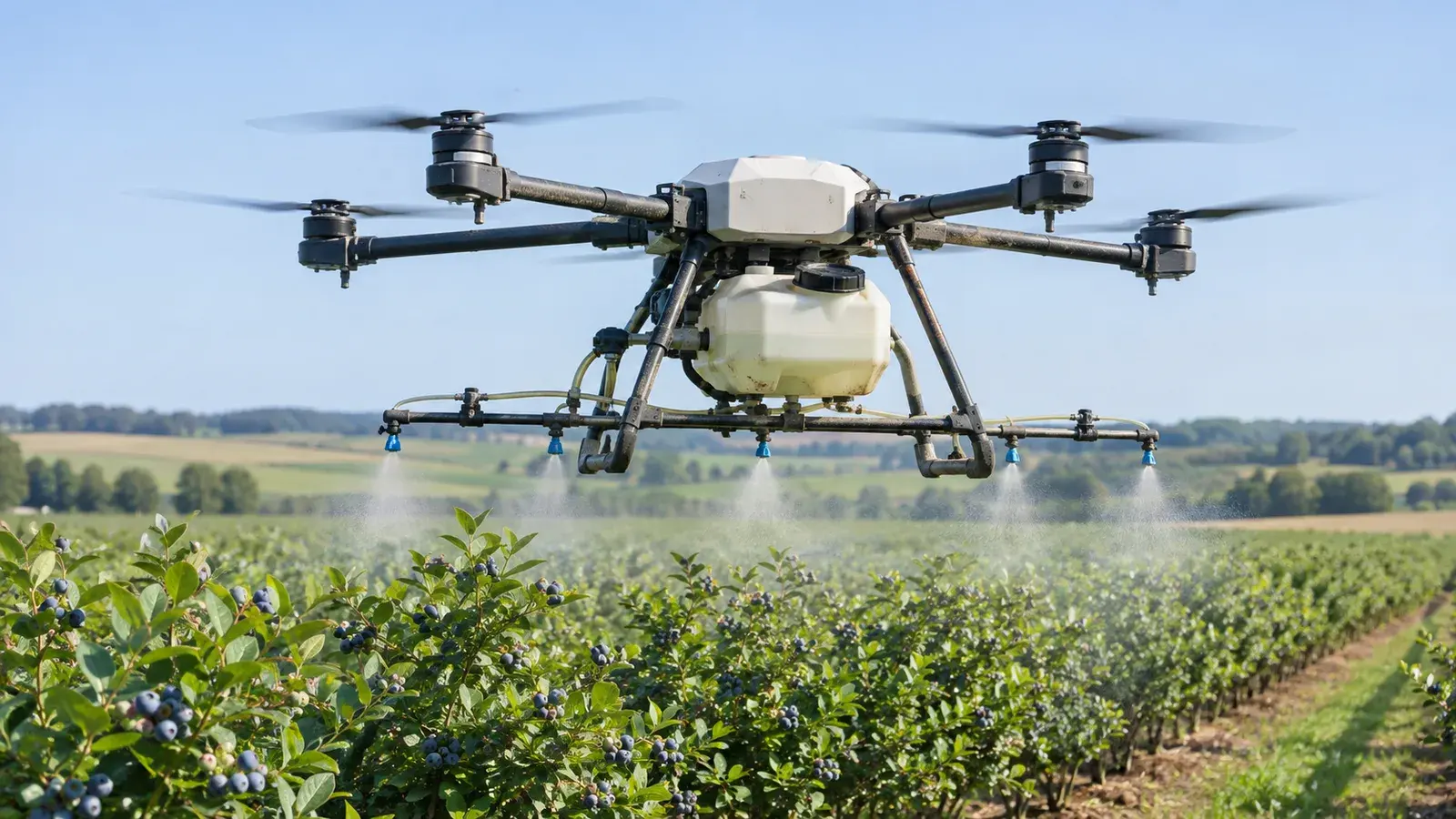
SpeedyDrone charges C$300 for an on-farm demo of up to 2 hours, plus C$1.50 per round-trip kilometre, and a demo shows the equipment and workflow, not a farm job or product test. A berry grower comparing contract work with ownership can review agricultural drones for Canadian farms and use that visit to judge the setup before deciding.
Can you legally spray your berry products by drone where you farm?
Three separate permissions must line up before a drone sprays a berry block: the product label, the aviation side and the province. Health Canada sets the label rule, Transport Canada the aircraft and pilot, and your province the applicator credential.
Step 1: Read each product's label for aerial use
Health Canada SPN2026-02 requires drone work to follow the label's aerial directions unchanged. A label silent on drones but permitting aerial use allows RPAS; a ban rules it out.
Step 2: Register the drone and match the pilot certificate to loaded weight
Health Canada requires pesticide pilots, farmers included, to register the drone and hold a certificate matching its type and size. A loaded aircraft over 150 kg, such as the T100, needs an SFOC.
Step 3: Get the provincial pesticide credential, in the right order
Drone spray rules in Ontario and Québec: Ontario's O. Reg. 63/09 s.73 covers aerial land extermination; Québec uses a C1 or D1 permit plus a CD1 certificate. SpeedyDrone tells farmers to check the provincial pathway and loaded class first, with the licence checker.
Which drone and spray setup suits berry rows and trellises?
The 40 L T50 and the 100 L T100 differ in spray tank size. Trellis wires, headlands and slopes often decide fit as much as tank size. A larger tank cannot fix a block without turn space.
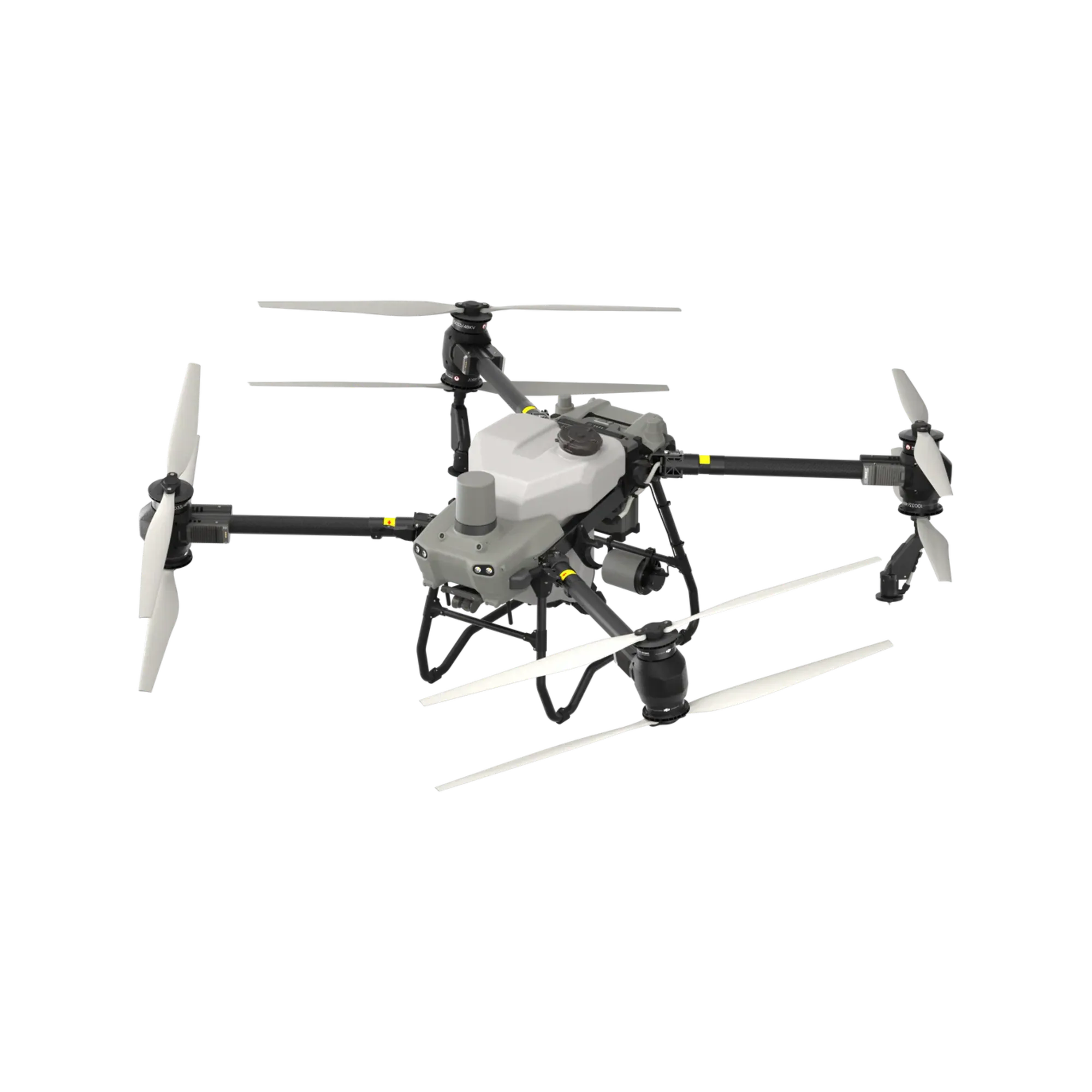
T50 and T100 spray systems side by side
| T50 | T100 | |
|---|---|---|
| Tank | 40 L | 100 L |
| Payload | 40 kg | 100 kg (sea-level) |
| Nozzle | 2 LX8060SZ sprinklers | 2 LX07550SX or 4 |
| Droplet | 50–500 μm | 50–500 μm |
| Swath | 4–11 m | 5–13 m |
| Flow | 16 L/min | 30 L/min |
Purdue PPP-154 gives GPM = GPA × MPH × W ÷ 5,940, W effective swath not maximum.
Atomizers, hydraulic nozzles and booms
Hydraulic nozzles match size to pressure, rate and speed; atomizers set droplet size. FABE-540 discourages booms beyond rotors.
Berry-block geometry SpeedyDrone checks first
SpeedyDrone checks trellis wires, short headlands, terrace edges and slopes before sizing.
T50 specs, packages and field kit details that aircraft.
Will the spray reach into the bushes without drifting off the block?
Coverage and drift on a berry block depend on height, wind and droplet size. A pattern test with clean water, followed by deposition checks where the product must land, is the only way to know whether your own bushes get it.
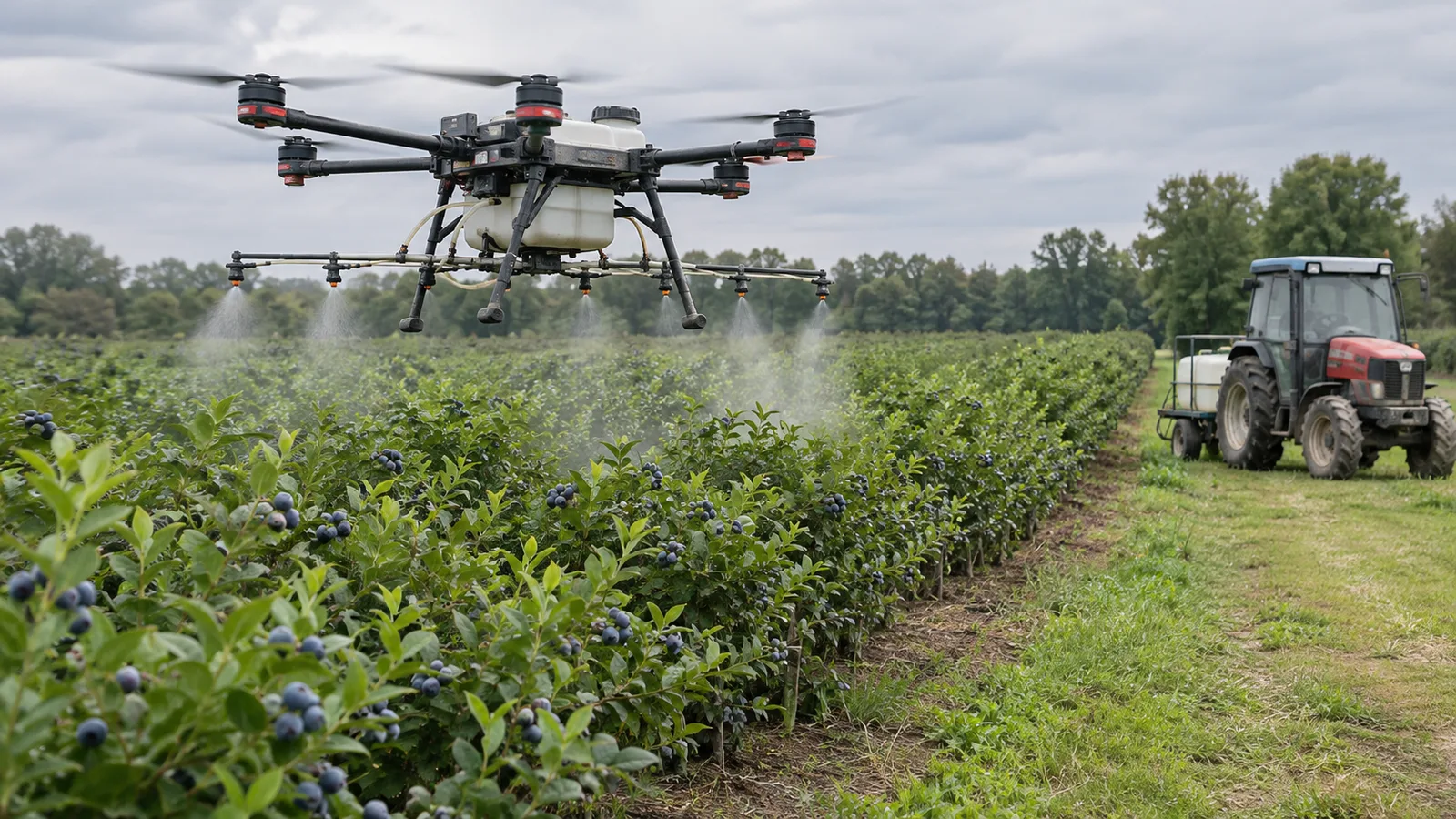
Height, wind and the buffer zone you must keep
Purdue PPP-154 reports flight over 10 feet above the canopy likely raises off-target drift. Smaller droplets raise coverage and drift, so the label's droplet rule leads. Ohio State FABE-540 calls wind usually the most critical drift factor. Health Canada SPN2026-02 has drones keep helicopter buffer zones.
Pattern-test with water before the first real load
Ohio State FABE-540 says no formula gives effective swath, so test a dye strip over white tape; the orchard and vineyard spraying workflow covers route planning and drift control. Purdue PPP-154 found 5 feet above pavement unacceptable. SpeedyDrone calibrates to the label's rate, carrier volume and droplets and runs a test strip, then checks a clean-water pattern at handover.
Check deposition inside the canopy, and know when a ground rig wins
Purdue PPP-154 lists blueberries among emerging spray-drone uses. The sources here hold no berry-canopy coverage trial. The company checks deposition where the product must land and recommends a ground rig when that rig reaches the target and the drone does not.
What you need besides the drone
A berry spray drone sprays only as fast as the ground crew can charge, mix and reload it, so budget the field kit and the people alongside the aircraft. A berry setup needs batteries, power, crew, mixing, PPE and insurance.
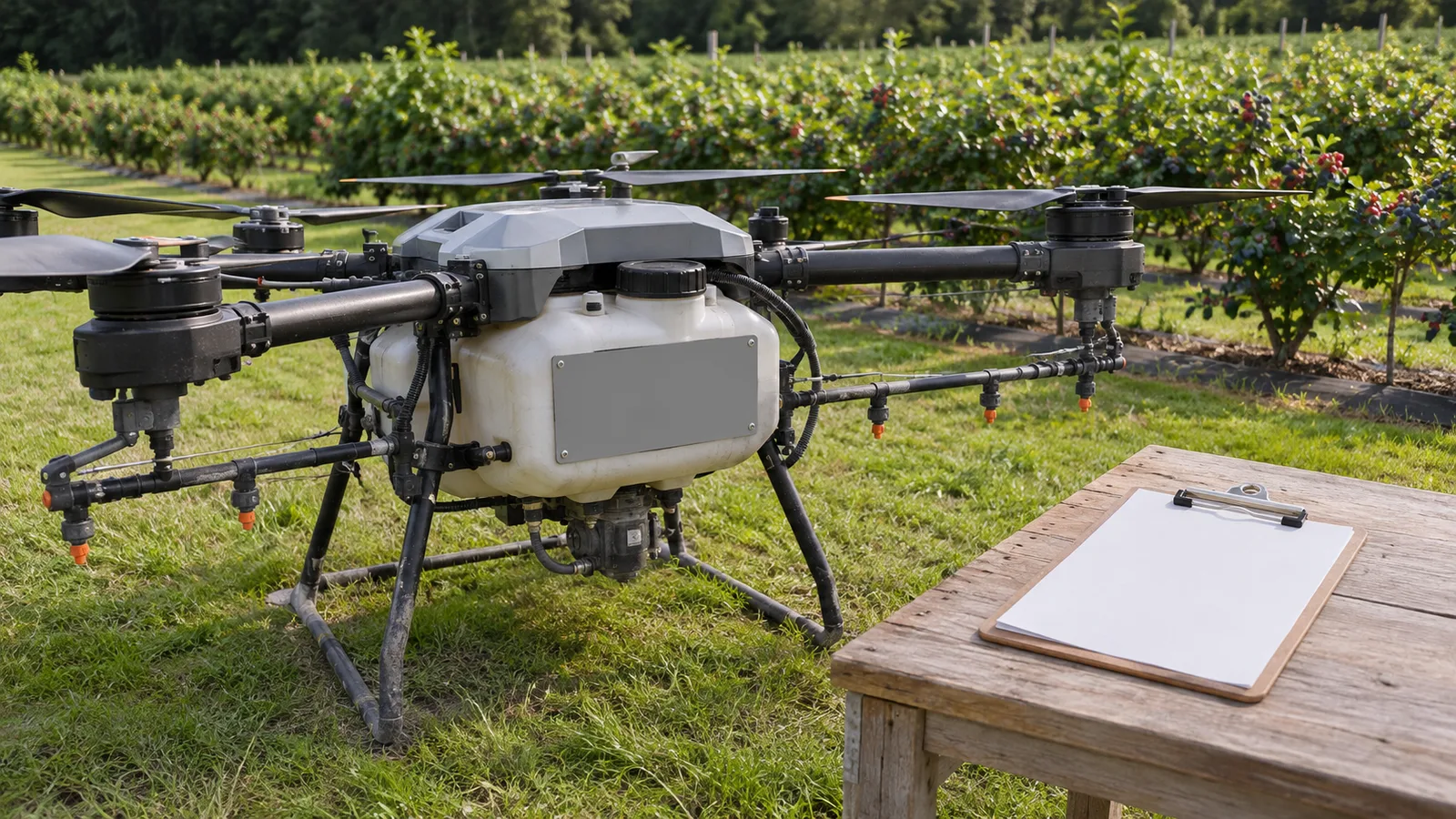
Batteries, charger and field power
- Purdue PPP-154 sets a three-battery minimum, up to 12, with a swap each tank refill.
- SpeedyDrone's field kit details cover a T50 package: three DB1560 batteries, charger or generator, spray system.
Crew, mixing and PPE, including battery swaps
- SpeedyDrone finds two work best; the battery helper wears label-required PPE as residues may remain.
- The checklist requires safe mixing, containment, documented calibration and spill preparedness.
Insurance before the first flight
- Purdue notes uninsured US$30,000 drone flights are risky; some U.S. regulators require liability proof. Confirm cover with insurer and province.
Buy, hire someone, or start a custom spraying business?
For a berry farm, buying, hiring a custom applicator and starting an application business are separate bets. Compare hiring against owning on the same acres, timing and acceptance standard, and count licences, kit and labour as well as aircraft price.
When owning makes sense
SpeedyDrone says farms under 1,000 acres can consider doing their own spraying. Above that, it looks at the specific situation. Purdue PPP-154 asks who will fly and whether they will have time in busy seasons.
Worked example: hiring versus a T50 package
Berry jobs may need assessment. C$29,999 buys a T50 three-battery package, C$48,505 a T100, before tax, generator, mixing gear, training, licences and insurance. List prices are not final; a written quote sets the price.
If you plan to spray for other berry growers
Purdue PPP-154 asks someone starting a custom spraying business to choose seasonal or full-time work, blueberries and licences. The buy or hire tool builds a break-even from your acres and prices.
Where SpeedyDrone fits, and when to look elsewhere
SpeedyDrone sprays by contract. As a DJI Authorized Dealer it also quotes aircraft and training, with support terms to check line by line. Every contract job is assessed, then quoted, then dated.
Hiring SpeedyDrone for a berry block
Contract pilots for a drone spray job need credentials, aircraft documents, pesticide permissions and insurance ready before a job is accepted. Contract application service requests need the province, aircraft and intended application.
Buying: what to verify in the quote and support terms
A configuration quote should list each component, condition and model number; factory faults at delivery go to DJI, while repairs are paid service.
Who should look elsewhere
A spray job with a large contiguous block, high carrier volume or tight deadline beyond crew capacity calls for a plane or helicopter quote.
Send SpeedyDrone your province, berry type, block layout and acreage, plus the product name, PCP number and current label, to request a spraying assessment. Written equipment quotes and demo requests also start on the contact page.
Sources
- Science Policy Document SPN2026-02, Allowing pesticide application by remotely piloted aircraft systems (RPAS;
- ag.purdue.edu
- DJI AGRAS T100: Specs: DJI
- DJI AGRAS T50: 技術規格: DJI
- Drones for Spraying Pesticides: Opportunities and Challenges | CFAES Knowledge Hub
- Drone operation categories and pilot certificates: Overview
- Using Remotely Piloted Aircraft Systems for pesticide application in Canada: What you need to know: Canada.ca
- Enabling the Use of Drones for Pesticides Application | Environmental Registry of Ontario
- Pesticide Label Search: Health Canada
- Certificates for the sale and use of pesticides | Gouvernement du Québec
- Canadian Aviation Regulations
- Drone operation categories and pilot certificates: Advanced operations
- Choosing the right drone for advanced and complex operations
- Canadian Aviation Regulations
- Pesticide Product Information Database: Health Canada
- Get permission for special drone operations
Frequently Asked Questions
Can the same drone spread granular fertilizer in berry alleys, and what are the T50 spreader limits?
The T50 can spread granular fertilizer in berry alleys only as a candidate, once a compatible spreader and material produce a demonstrated confined pattern; granule-size fit alone does not show alley delivery. DJI lists a 75 L tank, 50 kg load, 8 m width and 0.5-5 mm dry granules, with load limited to what the DJI Agras app recommends.
Can a drone spot-spray only part of a berry block?
Spot-spraying part of a berry block is feasible: Ohio State University Extension describes mapping the target with an RGB or multispectral camera, then loading polygons into the spray drone’s flight plan so nozzles spray at those GPS coordinates. For a regulated liquid task, the current federal product label, Ontario or Québec provincial requirements and flight conditions remain separate checks.
Can I rent a spray drone for one season instead of buying?
Renting for one season is handled as a project: SpeedyDrone rents drones by project, with or without one of its pilots, and a person quotes terms for the job, dates and who will fly. Purdue Extension PPP-154 advises comparing cost per acre with hiring custom application before buying, because drones depreciate and support equipment adds cost.
What should I check before hiring a drone applicator in Ontario or Québec?
Before hiring, record the pesticide registration number, crop, field location, business and applicator names; check pesticide permissions separately from pilot qualifications. Ontario’s aerial exterminator licence allowed applications while drone-specific rules were proposals on 13 November 2026; Québec requires a C1 or D1 business permit and a CD1 certificate or supervision. The 300 m map is an extent, not a setback.
Where does SpeedyDrone's spray drone training take place, and does it lead to a certificate?
AlteX droneHUB provides certificate training, booked in King, Ontario; the course site is confirmed at booking, and separate half-day Agras sessions confirm place at booking. SpeedyDrone is not a Transport Canada examiner, qualified reviewers run flight reviews, no one can promise a pass, and the general flight courses are not Agras training.
Should I buy a spray drone now or wait for the technology and rules to settle?
Ohio State University Extension advises buying only if you are well informed about the technology, aware that rules may change quickly and have viable uses; otherwise wait until adequately informed. Purdue Extension PPP-154 asks who will apply, whether labour and acres justify the cost, and notes drones depreciate quickly; compare buying with hiring custom application.